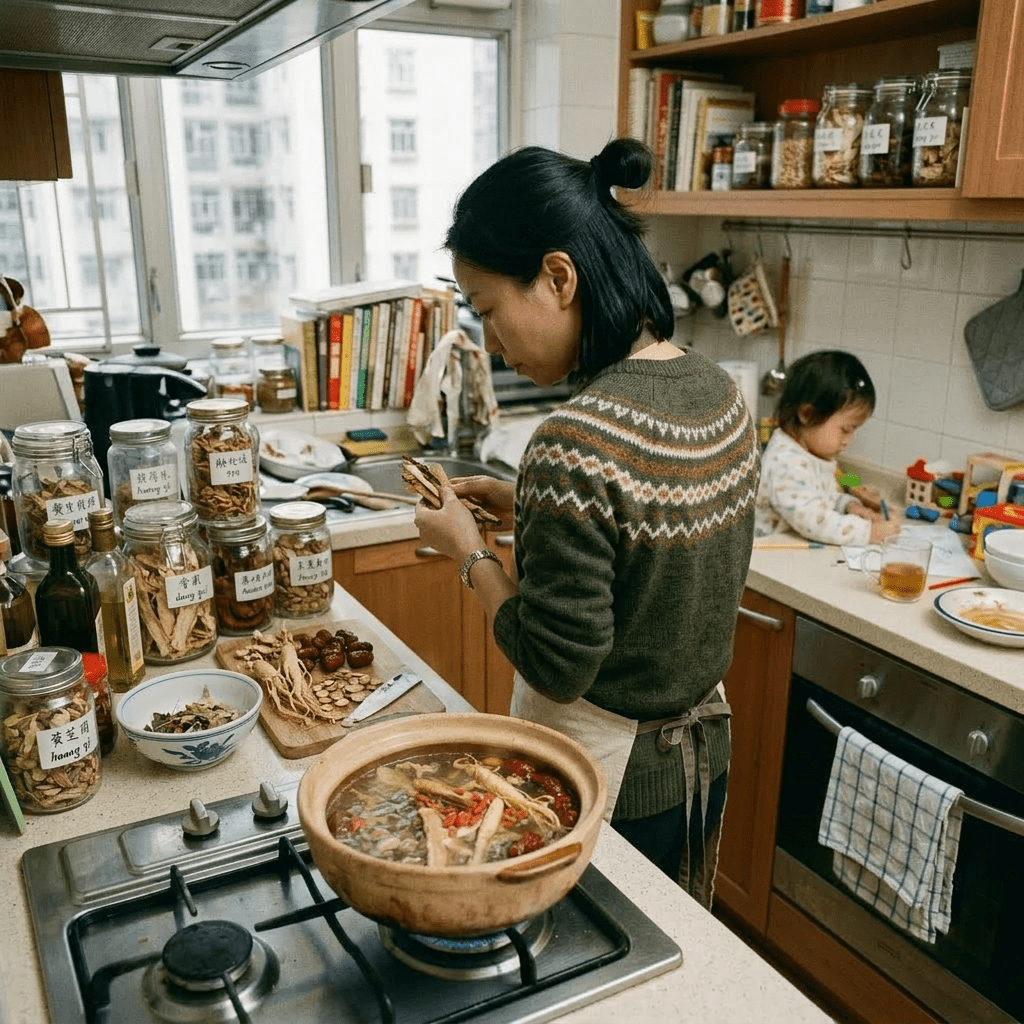
I grew up drinking TCM soups. My family made them regularly, and I drank them mostly because I was told to, or because I needed to stay warm in the Winter and hydrated in the Summer months. I did not really think about what was in them or why. They were just part of being in a Chinese household.
That changed when I was pregnant with my older son.
My mom came to take care of me during zuo yue zi, the traditional Chinese postpartum confinement month. That was the first time I really paid attention. She cooked for me every day and explained what she was making and why. In TCM (Traditional Chinese Medicine), giving birth depletes a woman’s Qi and blood, leaving the body in a state that is described as empty and cold. Qi is the vital energy that runs through everything: your stamina, your digestion, your mood, your ability to recover. When it is out of balance, everything feels off, not just physically but emotionally too. The food, the rest, the herbs, all of it during zuo yue zi is about bringing that Qi back. And, as part of our culture and wanting to be taken care of after everything my body had just done, I was happy to listen and eat. I felt the difference.
When I was pregnant with my younger daughter, my mom was not able to be there. So I hired a yue sao and did a lot of my own research to fill in the gaps.
What I discovered is that zuo yue zi is not one fixed thing. The customs vary depending on where your family is from, what region, what generation, and who taught whom. My mom brought what she knew. Her friends added their own takes. My yue sao came with Taiwanese customs. I went deep into the Hong Kong and Cantonese approach because that felt closest to my family background. What we ended up doing that month was a mix of all of it and whatever felt right for me. Different traditions, same intention.
But I was specific about the TCM side. I knew what I wanted and I asked for it clearly. Bird’s nest every morning before breakfast on an empty stomach. Soups with specific herbs. That part was not up for negotiation.
That experience of having to advocate for my own recovery, of researching and piecing together different approaches and then directing my own care, is what made me take TCM seriously as a long-term practice rather than just a postpartum ritual.
I also learned that one month of zuo yue zi is not enough. It is a starting point, not a finish line. The replenishment your body needs after pregnancy and birth is not something you can front-load and then forget. That realization is what turned a postpartum practice into a long-term food philosophy for me and eventually for my whole family.
What TCM-Style Eating Looks Like in My House
I am not a practitioner. I am a mom who cooks with intention.
TCM-style eating for me means using ingredients that have been used for centuries to support Qi, blood, digestion, and resilience. It means making a big pot of soup once a week that quietly does a lot of work. It means thinking about food not just as fuel but as something that can either build you up or wear you down over time.
The anchor of my week is a chicken soup made in the Instant Pot. I use stewing hen when I can find it. It is an older, tougher bird than the chickens you find in most grocery stores, and that is exactly why it works for soup. The long cook pulls all the flavor and nutrients out into the broth. By the time it is done, everything good is in the liquid, not the meat. My husband still eats the chicken every time and I have stopped trying to explain it to him.
I always add goji berries and dried longan because they make the broth a little sweeter, and honestly that is why my kids drink it without complaint. I have also started adding poria, which is not something my family used when I was growing up but I have learned it supports kidney and liver health. Codonopsis and astragalus are the ones I reach for most often because they are gentle Qi tonics that help rebuild foundational energy without being too strong or stimulating. They are the kind of herbs that work quietly over time, which is exactly what I need on a week where I have already worked out, managed school pickups, and cooked three meals a day. The herbs rotate depending on what I have on hand, but the goji and longan are always in there.
Beyond the soup, a few times a week I eat bird’s nest in the morning on an empty stomach. This started as a postpartum habit and became a personal ritual. I also make peach gum dessert occasionally, or a quick sesame seed dessert when I am tired and want something warming without much effort. And a few nights a week I will make something collagen-heavy like beef tendon or chicken feet, which feel like extra support for my joints and gut on heavy training weeks.
I add collagen peptides to my morning coffee every day. It takes two seconds and I barely notice it. My bird’s nest is my more intentional collagen ritual. The coffee is just maintenance.
Healthy eating in my house does not have to be expensive, but it does require being mindful about ingredients. We cook at home a lot and rarely eat out, not just because it is healthier and I like full control over what goes into our bodies, but also because it is more affordable. When we are rushing from school to swim practice, snacks are usually something I have already made. Boiled eggs, simple rice balls, reheated soup.
The Teas I Drink and When
I keep rose tea and chrysanthemum tea on rotation.
Rose tea is my everyday companion. I sip it throughout the day. It is calming and gentle, and in TCM it is used to support liver Qi and ease mild digestive tension. I am not drinking it because I read a study. I am drinking it because it makes me feel better on a long afternoon than a second cup of coffee does.
Chrysanthemum is what I reach for when I feel overheated or when my brain has been running too fast. It is cooling, which in TCM terms means it helps bring down that mental and physical heat that builds up during a stressful stretch.
When stress goes past a certain point I take Xiao Yao Wan. It is a classical TCM formula sometimes called Free and Easy Wanderer, which I think is the most accurate name for what it does. It helps me feel less stuck, less tight, less like everything is piling up at once. I do not take it every day. I take it when I need it, and it works well alongside everything else I am already doing.
What I Tell Myself When I Think About Why I Do This
I have two young kids with full schedules. I work out before anyone is awake. I have a full time job, manage the household, the meals, the appointments, and everything in between. My body has to keep up with all of that, and if I am lucky, I still have another 40 to 50 years to live in it. That is not a small thing to think about.
The food I eat is one of the few things I have real control over. So I try to make it count.
It does not have to be expensive to be good. Most of what I cook is affordable. Stewing hen, bones, dried herbs, eggs, rice. The bird’s nest, abalone, sea cucumber, and fish maw cost more, but I buy them in bulk and they go a long way. I stock up when we drive down to Monterey Park or San Gabriel, where there is a larger Chinese community, more competition between shops, and noticeably better prices than what you find closer to home.
The whole system, soups, teas, supplements, costs less per week than a few takeout dinners.
If I had to distill it down to one idea it would be this: a big pot of TCM soup once a week is enough to shift the baseline. You do not have to overhaul everything. Postpartum is what made me take this seriously, but it did not stop there. It just became part of how I feed my family now.
Keep the momentum going,
Flywheel Mama




 Flywheel Mama
Leave a comment