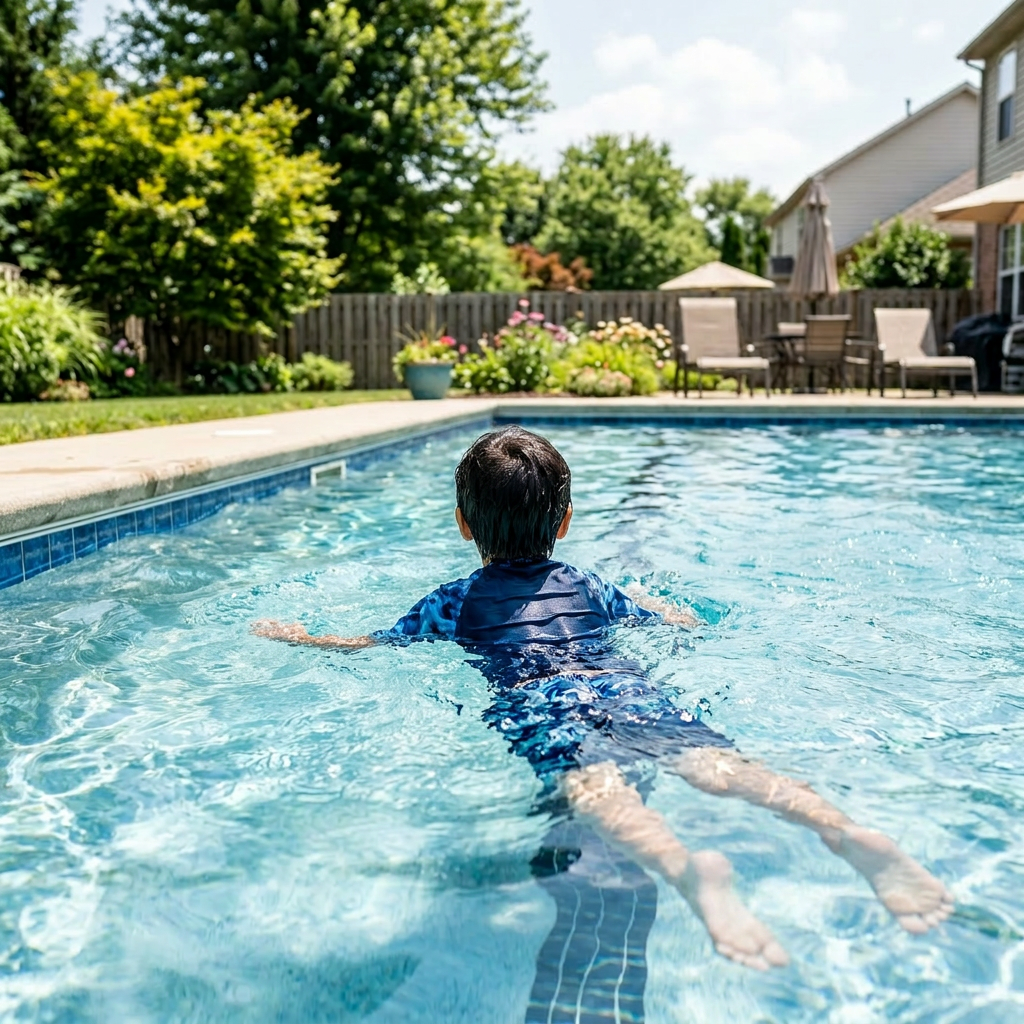
When my son was almost three years old, he fell into our backyard pool by accident. My husband and I were still inside changing into our swim suits when it happened. He had spotted his snail floatie in the water and decided, with complete confidence and zero hesitation, that he did not need to wait for us. He went to jump in on his own, misplaced his foot, and went in.
He was fine. My husband got to him immediately. But that moment settled the question of swim lessons faster than any conversation we could have had, because it told us exactly who our son is: a child who is fearless to the point where the water was not intimidating to him at all, which is its own kind of danger at that age. He was not afraid of the pool. He was overconfident about it. And that meant we needed him to have real skills in the water, not just a healthy respect for it.
That is how swim lessons started at our house. Not as an enrichment activity or an early sport introduction. As a direct response to a three-year-old who thought he could already swim by himself.
How We Built the Foundation Over Four Years
We started with private swim lessons at our own backyard pool when he was not quite three years old. The focus at that stage was entirely about comfort and familiarity, getting him used to the water, learning to float, getting his face wet without distress, and simply enjoying being in the pool. From there we moved into community swim classes before eventually finding American Swim Academy, which became the real turning point in his development as a swimmer.
American Swim Academy offered a structured, progressive curriculum in a warm heated indoor pool that took him from preschool level all the way through intermediate swimming over the course of several years. He learned proper freestyle technique and backstroke in an environment that was encouraging, consistent, and appropriately challenging without ever feeling overwhelming for a young child. By the time we finished at American Swim Academy, he had genuine ease in the water that only comes from years of proper instruction rather than casual splashing around.
That progression gave both of us something we needed before taking the next step. It gave him the ability. It gave me the confidence to think he might actually be ready to try out for a team.
Why Competitive Swimming and Not Just Recreational Lessons
There is a reason I chose to put my son on a competitive swim team rather than simply continuing with recreational classes indefinitely. A team environment teaches children things that a weekly lesson with no stakes simply cannot replicate. Learning to take correction from a coach who is not your parent, showing up to practice on a morning when you would genuinely rather stay home, competing in a race and processing the result no matter what it is, and measuring your own improvement against something real over the course of a season are life skills that happen to be delivered through swimming. That was always the point for me, not the ribbons. It is the same reason he is on a ski team at Palisades Tahoe and a soccer team — I want him to learn proper skills from people who know more than I do, in environments that challenge him in ways a casual class simply cannot.
How We Even Got Here: A Birthday Party Conversation
A classmate’s mom first mentioned the local swim team at my son’s birthday party. She was on the board as the registrar at the time and was recruiting kids from school, so the conversation came up naturally among the other moms there. What I took away from that first conversation was that it was a significant time commitment, a six-week pre-team summer program in the late mornings, team summer practices on top of that, and swim meets on Wednesdays and weekends. With a full-time job I did not see how we could make that work, so I put it aside.
But she mentioned later that there was a fall tryout option and that the commitment was much more manageable, just three practices a week. She also mentioned that the team needed more boys and thought our sons might be ready. That was really the pitch. We decided to try out and see what happened.
I did not tell my son it was a tryout. I told him it was a swim class where he would show the coach everything he knew, and that afterward we would go to McDonald’s. That was the deal. He did not need to know more than that, and honestly it was probably better that way. No pressure, no nerves, just show the coach what you can do and then get a Happy Meal.
I did not go in with high expectations either. We had built a solid swimming foundation over four years and I knew my son was comfortable in the water, but I was not walking into that tryout thinking he was going to make a competitive swim team. I was walking in thinking we would see what happened and go from there.
The Tryout: Cold Water and a Six-Year-Old With Opinions
When we decided to try out for our local swim team in the fall, the tryout itself was fifteen minutes in the water with one of the junior coaches, which sounded straightforward enough. What I had not fully accounted for was that our son had spent his entire swimming life in the warm heated indoor pools at American Swim Academy, and our local team practices in an Olympic-sized outdoor pool that is noticeably colder than anything he had swum in before.
He made sure the junior coach knew exactly how he felt about this.
He told the coach, without missing a beat, that the water was cold. Not as a complaint designed to get out of swimming but as a genuine piece of information he felt the coach should have. The coach handled it well, acknowledged his feedback, and then asked him to swim across the pool anyway. He did. We found out he made the team the next day.
Apparently only about half of the children who try out make it onto the team. I credit his freestyle, though I suspect his feedback about the pool temperature was also memorable.
What Made the Transition Easier: Familiar Faces and Real Belonging
One thing that made the jump from swim lessons to swim team feel natural and exciting rather than intimidating was that he already knew people on the team. Several of his closest friends from first grade were already swimming competitively, which meant that from the very first practice he walked into an environment where there were familiar faces, existing friendships, and a genuine sense of belonging waiting for him.
Those same friends who are stronger, faster swimmers than he is right now are also the ones who cheer the loudest for him at meets. That kind of team culture, where kids genuinely root for each other regardless of finishing order, is not something you can manufacture. It is built over time through shared experience, and he gets to be part of it from the very beginning of his competitive swimming life.
What His First Swim Meets Actually Looked Like
We signed him up for some weekend swim meets during the fall season so he could experience competition in a low-stakes way before committing to the full spring and summer schedule. He finished near the back of the field in his events, which did not seem to register with him as a problem at all.
What he loved about swim meets turned out to have very little to do with the races themselves. He loved sitting with his friends between events, eating snacks, playing, talking, and generally treating the entire meet like a wonderful social event that occasionally required him to get in the pool for a few minutes. When his event was called, he would calmly walk over, swim his race, and walk back to the tent to resume whatever conversation or game he had left behind. There was no anxiety, no drama, and no distress about where he finished. Just a child who was comfortable, happy, and completely at home in his environment.
That is exactly what I was hoping for when we started all of this with backyard safety lessons four years ago.
What This Season Looks Like Now
In his first full official season, he is practicing five days a week during spring and summer with swim meets on Wednesdays and Saturdays. It is a meaningful step up from the three-days-a-week fall schedule, and it requires real family coordination to make it work consistently. But watching him walk up to the blocks at a meet with that same unbothered, confident energy he brought to his very first tryout, the kid who politely informed a junior coach that the outdoor pool was cold and then swam across it anyway, makes every early morning and every packed week feel completely worth it.
We started this because we have a backyard pool and I wanted my son to be safe in the water. We ended up here because four years of proper instruction, progressive skill-building, and genuine enjoyment in the water created a foundation strong enough to hold everything that came next.
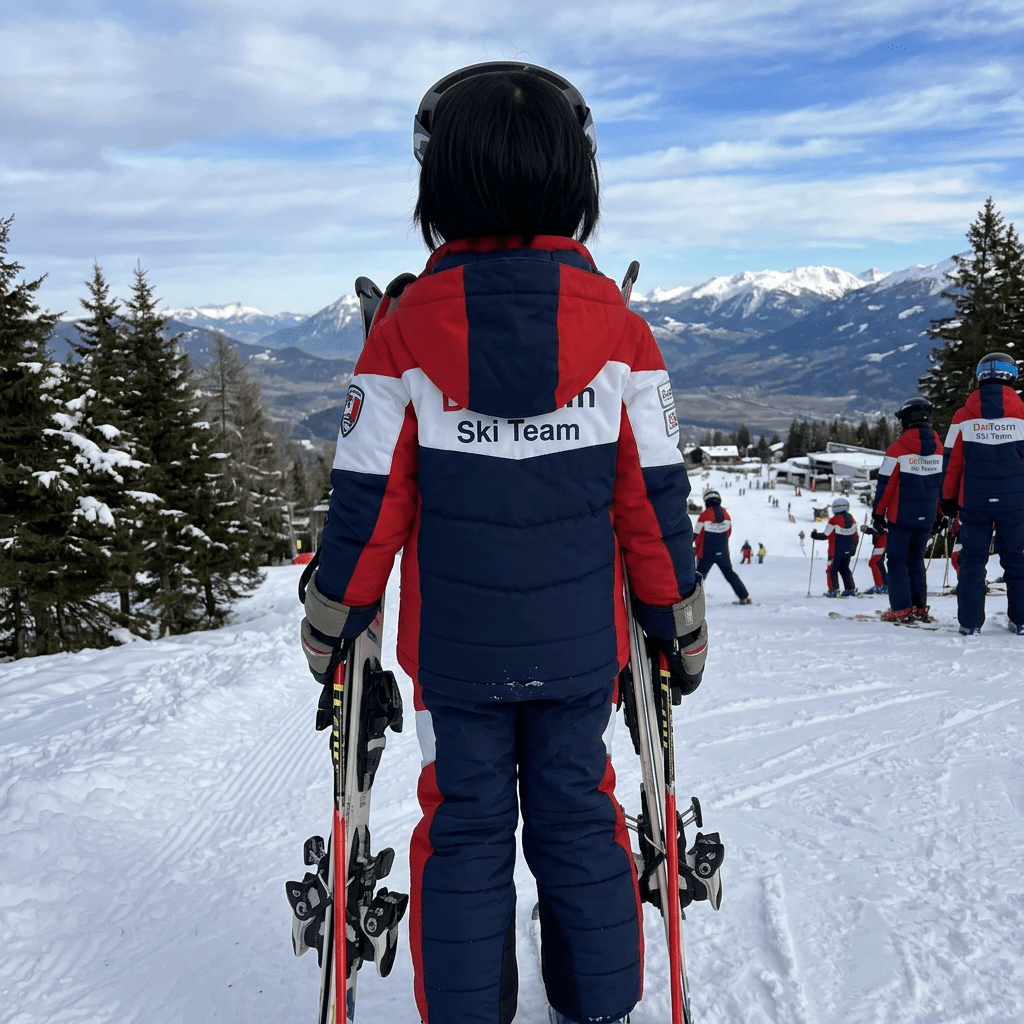
Swimming is one piece of a bigger picture for our family. If you want to read about how that same fearless energy translated to the ski slopes and eventually earned him a spot on the Palisades Mighty Mites ski team, that story is here too.
Fun first. Always fun first. The rest followed on its own.
Keep the momentum going,
Flywheel Mama
FAQ
At what age can a child start swimming competitively?
Children can start competing in swim events as young as six years old, with many youth programs offering races specifically for the 6 and under age group. Most competitive swim teams accept children starting around age five or six, as long as they have the water confidence and basic stroke foundation to participate safely and follow a coach’s direction.
How do I know if my child is ready to try out for a swim team?
A child is generally ready to try out for a swim team when they can swim a full 25-yeard lap independently, are comfortable putting their face in the water, and can follow basic directions from a coach without a parent present. Readiness is less about speed and more about water confidence and the ability to function in a structured group environment.
What is the difference between swim lessons and a competitive swim team?
Swim lessons focus on water safety, basic technique, and building comfort in the water at the child’s own pace. A competitive swim team builds on those foundations with structured coaching, stroke refinement, timed practices, and participation in meets. The environment is more team-oriented and requires a consistent weekly commitment from both the child and the family.
How long does it take to go from swim lessons to joining a swim team?
Most children who start swim lessons between ages three and four are ready to try out for a team by ages five to seven, depending on how consistently they trained and how quickly they developed water confidence. Four to five years of regular lessons is a reasonable foundation before making the jump to a competitive program, though every child develops at their own pace.
What should I expect at a youth swim team tryout?
Most youth swim team tryouts are short, typically around fifteen minutes, and involve a junior coach watching the child swim a basic distance to assess their stroke, comfort in the water, and ability to follow direction. There is no need to prepare extensively. The coach is looking for foundational water skills and coachability, not speed or perfection. Coming in relaxed and letting your child show what they already know is the best approach.




 Flywheel Mama
Leave a comment