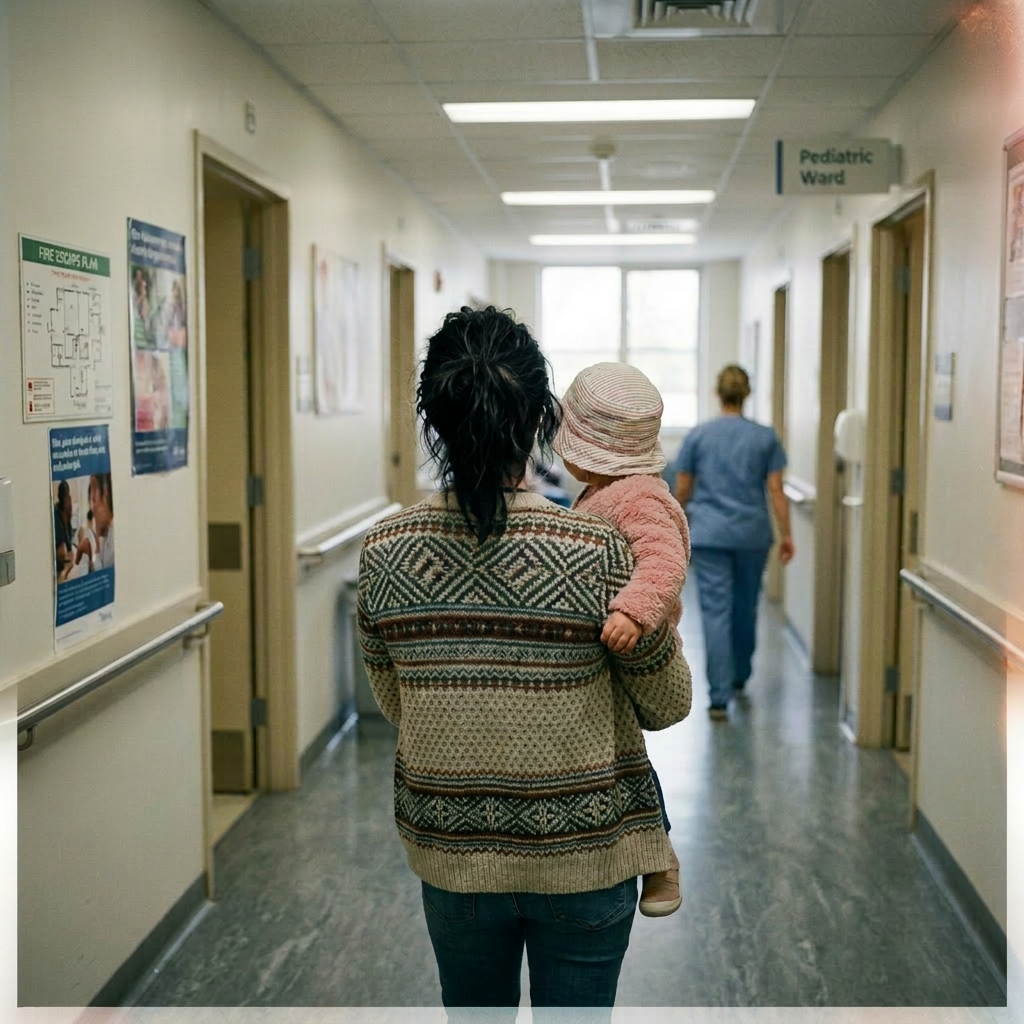
When I wrote our original ADEM story back in December, I genuinely believed our next update would be the easy one. Our daughter had recovered fully. She was running, laughing, and doing her ballet routines like nothing had ever happened. We had done the hard part, and we were ready to close this chapter and move forward.
But if this journey has taught me anything, it is that recovery and resolution are not always the same thing. As her mom, I have had to sit with that distinction more than once over the past few months.
Why We Scheduled the 6-Month Follow-Up MRI
After an ADEM diagnosis, a follow-up MRI around the six-month mark is standard protocol. The goal is straightforward: confirm that the original brain inflammation has cleared and that the white matter lesions from the initial episode have resolved. We went into that March 2026 appointment feeling cautiously optimistic. She had been doing so well, and we had no reason to expect anything other than a clear scan.
The original lesions were gone. Her brain had healed from the August 2025 ADEM episode exactly the way her neurologist had hoped, and that was genuinely worth celebrating.
What we were not expecting was what came next. The scan also showed new T2/FLAIR white matter lesions, inflammation marks in a different part of her brain that had not been there before. The deep gray matter areas most affected during her original illness, the thalami and basal ganglia, had actually improved. But these new spots had appeared elsewhere in the supratentorial white matter, and that finding changed the entire conversation we were having with her care team.
What New Lesions After ADEM Can Mean
ADEM is typically described as a monophasic condition, meaning it happens once, the immune system settles, and the brain recovers. When new lesions appear on a follow-up MRI after a child has already recovered from ADEM, the medical team has to ask a harder question: was this always ADEM, or is something else driving the inflammation?
Her neurologist walked us through the differential diagnosis, which is the list of conditions that could explain the new findings. The possibilities her team mentioned included MOGAD (Myelin Oligodendrocyte Glycoprotein Antibody Disease), where the immune system attacks the protective myelin coating around nerve fibers; CNS vasculitis, which is inflammation of the blood vessel walls inside the brain; autoimmune encephalitis, where the immune system produces antibodies that affect brain function; CNS-HLH (Hemophagocytic Lymphohistiocytosis), a serious immune overactivation syndrome; and multiple sclerosis, which is less common at her age but kept on the list for completeness.
I am sharing these names simply because other ADEM families going through a similar workup have asked what conditions get investigated when a follow-up scan shows new findings. I want to be clear that I am not explaining what these conditions mean for any other child or suggesting what any family’s results might indicate. That is a conversation that belongs entirely between a family and their medical team.
The Testing Process and What Has Been Ruled Out
Her neurologist and the team began a systematic workup, ordering a series of blood tests designed to either confirm or eliminate the conditions on that list. Here is a summary of where things stand based on what her doctors shared with us.
Her MOG-IgG antibody test came back negative. Her full celiac panel, including IgA anti-TTG and IgG anti-DGP, also came back negative, and her serum IgA level confirmed those results were reliable. The Epstein-Barr Virus antibody panel was completely negative across all four markers, meaning there is no evidence of a current or past EBV infection. Her 25-hydroxy Vitamin D level came back at 34 ng/mL, which her lab listed as within the normal range of 25 to 80 ng/mL.
Here is a summary of the results her care team reviewed with us:
| Test | Our Daughter’s Result | Lab Normal Range |
|---|---|---|
| MOG-IgG antibody (FACS cell-based assay) | Negative | Negative |
| IgA anti-TTG antibody (celiac panel) | Negative / less than 1.0 U/mL | Less than 8.0 U/mL |
| IgG anti-DGP antibody (celiac panel) | Negative / less than 1.0 U/mL | Less than 8.0 U/mL |
| Full EBV antibody panel (VCA IgG, VCA IgM, EA IgG, EBNA IgG) | All negative | Negative |
| 25-hydroxy Vitamin D total | 34 ng/mL | 25 to 80 ng/mL |
| ESR (erythrocyte sedimentation rate) | Elevated, trending down from 65 to 34 mm/hr | 0 to 10 mm/hr |
| CRP (C-reactive protein) | Elevated at 1.9 mg/dL | Less than 0.5 mg/dL |
Two results, the ESR and CRP, remain elevated and are the focus of ongoing investigation by her care team.
The Number That Is Giving Our Family Hope
When we first tested her ESR in April, it came back at 65 mm/hr. Normal for a child her age is under 10 mm/hr, so that reading was significantly elevated. When we retested in May, it had dropped to 34 mm/hr, which is nearly a 50 percent reduction over six weeks. Her care team noted that this kind of downward trend is a meaningful sign, and while her levels are still above the normal range, seeing that number move in the right direction has given our family something to hold onto through all of the uncertainty.
One detail we also mentioned to her doctors: her March MRI showed some sinus thickening, and she came down with a fever and an upper respiratory illness the week after that scan. It is very possible that illness was already developing at the time of imaging. Her care team has taken note of this as part of the full picture they are putting together.
Our Referrals and Next Steps
Because our daughter’s case sits at a very specific intersection of the immune system and the nervous system, her neurologist referred us to a pediatric neuroimmunologist. This is a subspecialty that focus precisely on conditions where the immune system and the brain are both involved, and given the complexity and seriousness of what her team is investigating, we felt it was the right step to pursue that level of specialized care.
We do not have a new diagnosis yet. We are still in the process of gathering answers, and that process takes time. For now, the approach is to watch and wait carefully while we monitor her condition with blood tests every 12 weeks to track her inflammation markers over time. We do not have a new diagnosis yet, but we have a team that is paying close attention, and that matters enormously.
How Our Daughter Is Doing Right Now
This is the part I most want other ADEM families to read. She is doing well day to day. She is not having seizures. She has not lost any skills or language. She does not have weakness or behavioral changes that concern her care team. When she is awake, she is completely herself — talkative, playful, and full of opinions about everything.
The one thing we have noticed is that she still takes long afternoon naps, sometimes close to two hours. We mentioned this to her neurologist, who is tracking it alongside everything else. Post-ADEM fatigue is something many families in the ADEM community have shared that they experienced during recovery as well. We are not dismissing it, but we are also not panicking over it given how otherwise stable she appears.
She has absolutely no idea that her March MRI prompted a flurry of specialist conversations and a referral to one of the top pediatric programs in the country. She just wants to know if she can have a snack and go to ballet.
A Chapter We Are Still Waiting to Close
As much as we wanted this chapter to be behind us by now, it isn’t. And that is something I have had to make peace with in my own way.
We are genuinely hoping to close it soon, before she starts fresh in Transitional Kindergarten this fall. She deserves to walk into that new chapter as a healthy, carefree little girl with nothing but excitement ahead of her, and that is what we are working toward. In the meantime, we will continue showing up for every appointment, completing her blood draws every 12 weeks as her doctors have asked, and trusting the process even on the days when the waiting feels impossibly hard.
The doctors have told us to watch and wait, and so that is what we are doing; watching her closely, waiting for the answers to come, and choosing hope every single day.
A Note to Other ADEM Families Reading This
I want to say this clearly: I am not a doctor, and nothing in this post should be taken as medical information, guidance, or advice of any kind. I am sharing our family’s personal experience only, including the questions we have been asking, the process our care team is walking us through, and how we are feeling emotionally through all of it. If your child has had an ADEM diagnosis or you are concerned about any symptoms, please reach out to a qualified pediatric neurologist or your child’s physician directly.
What I can offer is this: if you are a family somewhere in the middle of a follow-up workup after a pediatric ADEM diagnosis, please know that you are not alone. The six-month MRI may not give you the clean finish line you were hoping for. That does not mean your child is not recovering. Our daughter looks and acts healthy, and we are still in the middle of an investigation that is not finished yet. Both of those things can be true at the same time, and sitting with that uncertainty is one of the hardest parts of this experience.
We will keep sharing updates here as we learn more. She is still here. She is still spinning in ballet class and asking for one more story before bed. And for right now, that is everything.
Keep the momentum going,
Flywheel Mama

A Bay Area millennial mom of two, working full-time in marketing while raising a family and keeping all three legs of the stool standing. Flywheel Mama shares genuine, unfiltered perspectives on parenting, career, TCM wellness, and Bay Area family life, so that others like her know they’re not alone.
Keep the momentum going.
A Bay Area millennial mom of two, working full-time in marketing while raising a family and keeping all three legs of the stool standing. Flywheel Mama shares genuine, unfiltered perspectives on parenting, career, TCM wellness, and Bay Area family life, so that others like her know they’re not alone.
Keep the momentum going.






Leave a Reply